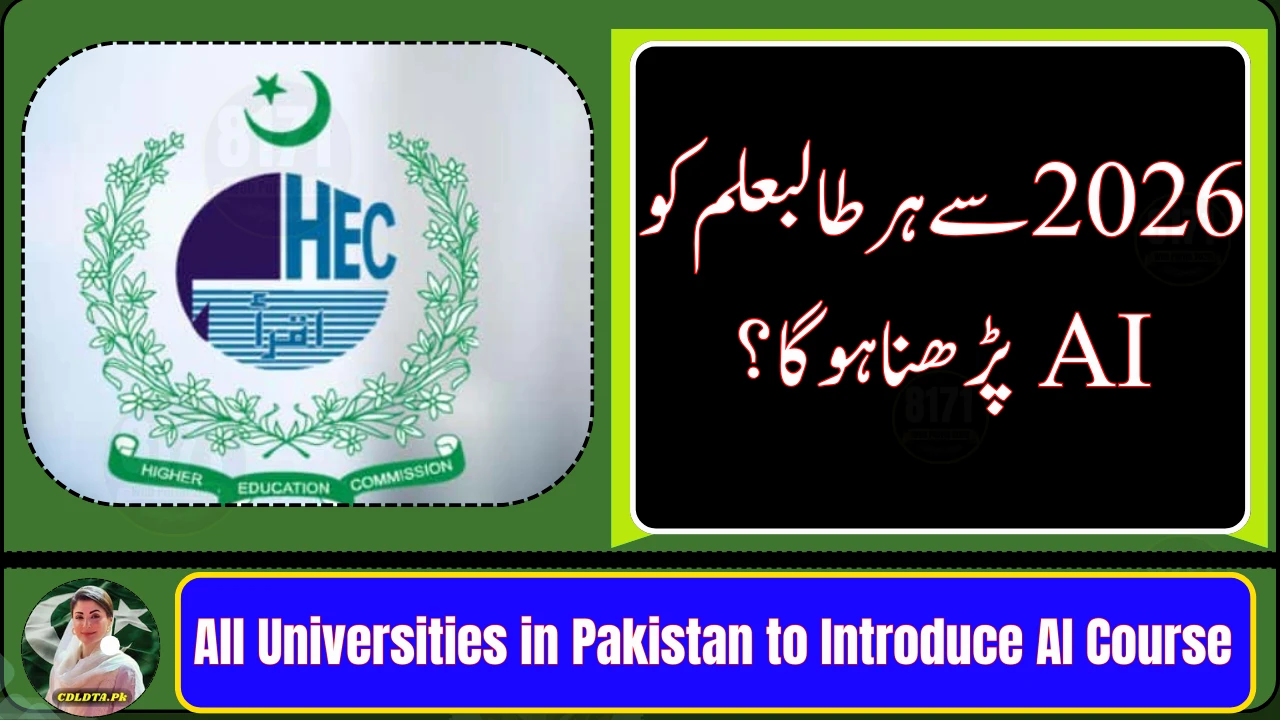
In a major academic reform, the Higher Education Commission (HEC) has directed all public and private universities in Pakistan to introduce a mandatory three credit hour course on Artificial Intelligence (AI) in every undergraduate and postgraduate degree program.
This decision marks one of the biggest curriculum shifts in Pakistan’s higher education system and will be implemented from the Fall 2026 academic session.
 Xiaomi 17 Ultra Global Launch Confirmed – Pakistan Release Expected Soon
 Meta to Shut Down Messenger App Completely – Deadline Announced
What Exactly Has HEC Announced?
According to the official advisory:
-
Every university must introduce a 3-credit hour AI course
-
The course will apply to undergraduate and postgraduate programs
-
Implementation will start from Fall 2026
-
Institutions can structure it as elective, interdisciplinary module, or allied subject
This means whether a student is studying business, medicine, engineering, social sciences, or arts — Artificial Intelligence will now become part of their academic journey.
Why Is AI Being Made Compulsory?
HEC stated that Artificial Intelligence now plays a central role in:
-
Education systems
-
Healthcare innovation
-
Economic growth
-
Governance and policymaking
-
Digital services and automation
Pakistan’s higher education regulator believes that students must understand not just AI tools but also the ethical and social dimensions of this technology.
The goal is not to turn every student into a programmer — but to build foundational AI literacy across all disciplines.
Xiaomi 17 Ultra Global Launch Confirmed – Pakistan Release Expected SoonMeta to Shut Down Messenger App Completely – Deadline Announced Gold Price Jumps by Rs. 7,100 Per Tola – Fresh Record in Pakistan
What Will Students Study in This AI Course?
Universities have been instructed to cover:
Core AI Concepts
-
Basic machine learning principles
-
Data-driven decision making
-
AI applications in daily life
Cross-Disciplinary Applications
-
AI in business analytics
-
AI in medical diagnostics
-
AI in public policy and governance
-
AI in media and communication
Ethical & Legal Issues
-
Data privacy
-
Transparency
-
Algorithmic fairness
-
Accountability
-
Societal impact
Institutions are allowed flexibility to adapt content according to their specific degree programs.
How Universities Can Structure the Course
HEC has given universities three possible approaches:
-
Offer it as a compulsory core subject
-
Introduce it as an elective option
-
Add it as an interdisciplinary or allied module
This flexibility ensures that universities can align the course with their academic strengths while meeting regulatory requirements.
What This Means for Pakistani Students
For students across Pakistan, this announcement means:
-
Increased exposure to emerging technologies
-
Better career readiness
-
Improved digital literacy
-
Enhanced global competitiveness
With AI reshaping job markets worldwide, graduates with even basic AI understanding will have an advantage in both local and international markets.
Why This Decision Matters for Pakistan’s Future
Globally, countries are integrating AI education into mainstream curricula. By making AI a required subject, Pakistan is:
-
Aligning with global academic trends
-
Preparing youth for digital economy jobs
-
Strengthening innovation capacity
-
Supporting long-term economic transformation
This move signals that Pakistan’s higher education system is adapting to technological disruption rather than resisting it.
Xiaomi 17 Ultra Global Launch Confirmed – Pakistan Release Expected SoonMeta to Shut Down Messenger App Completely – Deadline AnnouncedGold Price Jumps by Rs. 7,100 Per Tola – Fresh Record in Pakistan POCO X8 Pro Max – Full Leaks, Specs & Expected Global Launch Details
 Home Charging System Launched for Electric Vehicles in Pakistan
 Electricity Prices Set to Rise Again – Government Prepares Fresh Per Unit Increase